
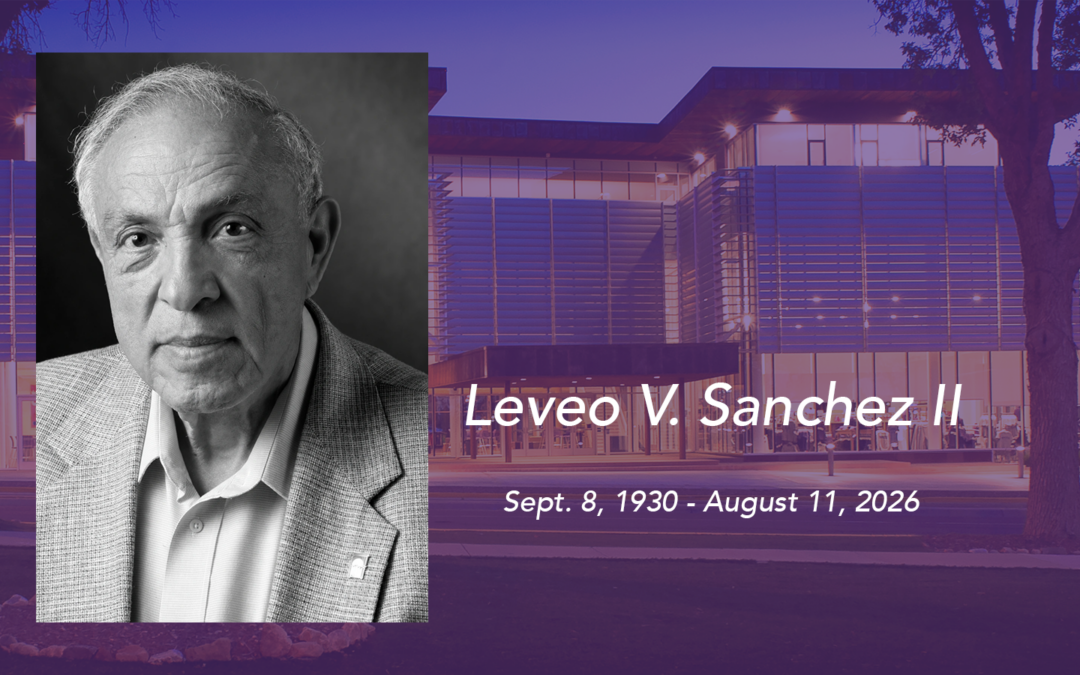
A moment of silence in Sanchez Family Stadium will recognize an alumnus whose service leadership and generosity shaped the university across generations
When the Highlands community gathers for Homecoming on Saturday, Oct. 3, the name above the football field will carry particular meaning. During the game at Sanchez Family Stadium, New Mexico Highlands University will hold a moment of silence for Leveo V. Sanchez II, the alumnus, former regent and benefactor whose relationship with the university began in childhood and continued for nearly a lifetime.
Sanchez died Aug. 11, 2026, at his home in Santa Fe. He was 95. His work took him from northern New Mexico to Washington, D.C., Latin America and more than 100 countries, yet Highlands remained a constant point of return. He served the university as a student, employee, Foundation leader and chair of the Board of Regents. With his wife, Patricia, he also invested in scholarships, academic initiatives and facilities used by both the university and the Las Vegas community.
A childhood shaped by Highlands

Leveo Sanchez
Leveo's earliest memories of Highlands reached back to age two, when he accompanied his mother to campus. As a teenager and young adult, his connection became practical as well as personal. He worked in the university maintenance department, beginning as a dandelion digger for 34 cents an hour. He later dug ditches for a new central heating system and helped haul sand from Tecolote in the university's lone dump truck.
Those jobs gave Sanchez an early view of the labor required to build and sustain an institution. He described himself as a good worker and carried that ethic into his education, public service and business career.
Education military service and a wider world
Sanchez spent part of his youth in Guatemala, where his mother's work in rural education introduced him to Latin America and awakened an interest in diplomacy and development. He returned to northern New Mexico for his senior year at Las Vegas High School and enrolled at Highlands in 1948.
While a junior, he left the university to join the U.S. Army during the early years of the military's racial integration. He graduated from the Army Corps of Engineers Officer Candidate School and served as an officer in Europe during the Korean War era. The experience strengthened his ability to work across cultures and communities, a skill that would define much of his later career.
After his military service, Sanchez returned to Highlands and completed his bachelor's degree in economics. He then earned a master's degree in foreign affairs with a concentration in Latin American studies from George Washington University in Washington, D.C.
A career in public service and economic development
Sanchez began his international public service with the U.S. Agency for International Development. He worked on the Peru and Ecuador desk in Washington and later served in Lima, Peru, where he became a liaison to the newly established Peace Corps. He went on to evaluate Peace Corps programs in Latin America and the Caribbean and later served as deputy director of the organization's Latin American Region.
His federal service also included leadership of the U.S. Office of Economic Opportunity's Mid-Atlantic Region and the Office of Institutional Development in the Latin American Bureau of USAID. These posts placed him at the intersection of government, education and economic opportunity.
In 1969, Sanchez founded Development Associates, an international consulting firm specializing in social and economic development. Under his leadership, the company grew into one of the nation's largest minority-owned and operated consulting firms, with offices in eight U.S. cities and projects in more than 100 countries. He sold the firm in 2005. He also helped establish Hemisphere National Bank, a minority-owned institution created to serve a growing Hispanic population, and held leadership roles with national civic and cultural organizations.
Returning his experience to Highlands
After more than five decades on the East Coast and abroad, Sanchez and his wife returned to New Mexico in 2006. Two years later, he was appointed to the New Mexico Highlands University Board of Regents. He went on to serve three terms and chaired the board, bringing decades of business, government and international experience to the university's governing body.
Sanchez described his priorities in direct terms. He wanted Highlands to improve recruitment and retention, develop new academic programs and strengthen its statewide centers. He viewed service on the Board of Regents as an active responsibility and consistently connected institutional decisions to opportunities for students.
His formal leadership extended well beyond the regents. Sanchez served 21 years on the New Mexico Highlands University Foundation Board, including a term as president, and remained active in the Washington, D.C. alumni association for nearly 30 years. These roles allowed him to connect alumni, donors and university leaders around projects that could make an immediate difference for students.
Investments in students programs and facilities
Over many years, Sanchez and Patricia gave approximately $1.6 million to Highlands. Their support reached across the university, from student scholarships to travel assistance for the marching band. One gift helped the university's marching band travel to Washington, D.C., to perform during President Bill Clinton's inauguration. It also transformed the university's athletic facilities. The couple donated $500,000 to replace the football field and another $100,000 to renovate the Stu Clark athletics building. The stadium was later named Sanchez Family Stadium in recognition of the family's support.
Their philanthropy also preserved access to education. Sanchez established the Victoria D. de Sanchez Scholarship in honor of his mother and the Leveo V. Sanchez Scholarship. The endowed funds created a direct connection between his family's educational history and future generations of Highlands students.
Sanchez also pledged the first $50,000 as a challenge grant for a Foundation campaign to establish a Center of Excellence focused on improving math and science teaching in New Mexico middle schools. The initiative reflected a belief he shared with his mother that education should strengthen communities as well as individual lives.
The Sanchez story is inseparable from Highlands. Victoria helped expand the reach of teacher education. Leveo carried that commitment into international development and then returned his experience and resources to the university where his own education began.
A moment of remembrance at Homecoming
The moment of silence during Homecoming will bring Sanchez's story back to a place shaped by his generosity. The stadium carries his family's name because he and Patricia helped ensure that Highlands athletes could compete on a safer field and that students, families and community members could continue gathering there.
The observance will also recognize the breadth of his service. Sanchez knew Highlands as the child of a professor, a maintenance worker, a student, an alumnus, a donor, a Foundation president and a regent. Few people have experienced the university from so many perspectives or sustained their connection across so many decades.
The 2026 Homecoming football game begins at 6 p.m. Saturday, Oct. 3, when the Cowboys host Western Colorado University at Sanchez Family Stadium. Homecoming activities run from Wednesday, Sept. 30, through Saturday, Oct. 3.